
The patient sees you looking down: How screen time during consultations affects trust
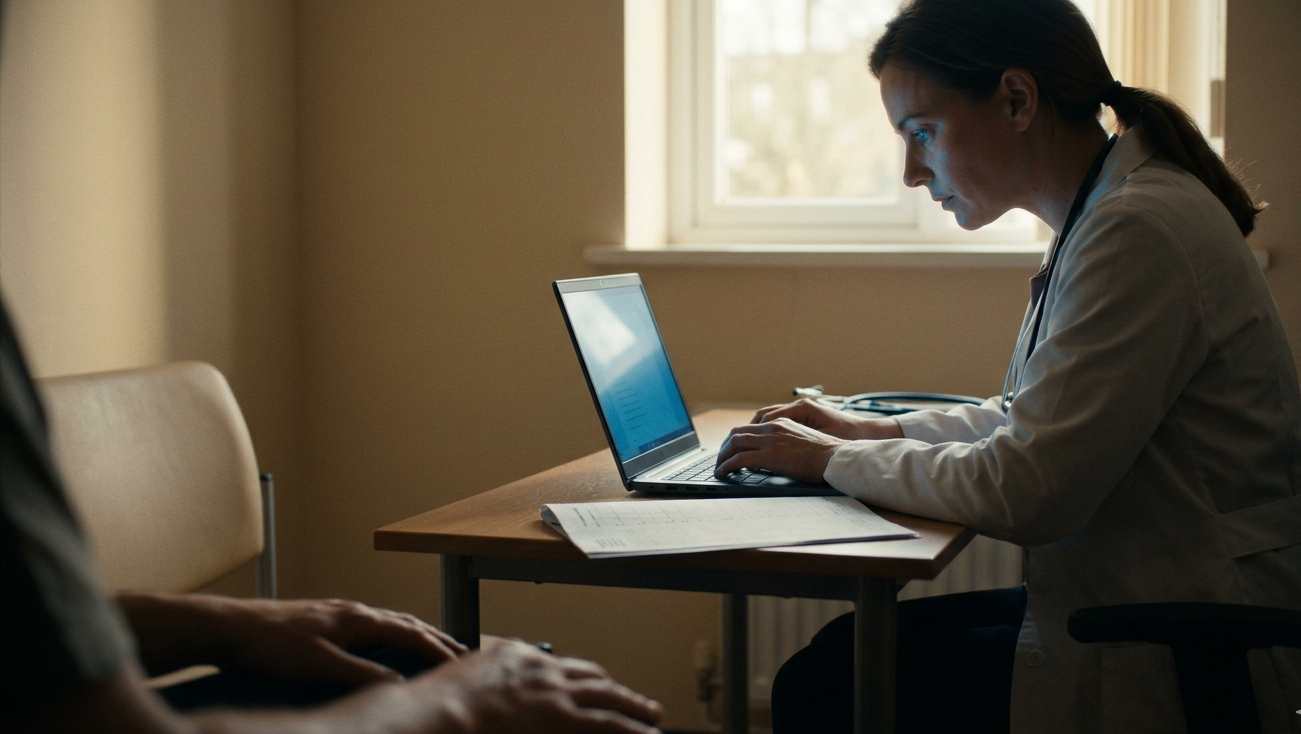
The patient has practiced the same sentence all week. Now she's sitting in the chair, and you've just started typing. She starts anyway — but you don't register her facial expression. You look down at the keyboard.
Most of what we've written about journaling here on the blog has focused on din side of the table. Time spent, documentation fatigue, legal requirements, tools. But there is another person in the room who is also experiencing the consultation — and who notices exactly how much of your attention is on the screen instead of on her.
The patient's perspective on record-keeping is rarely a topic in professional debate. But it should be. Because what the patient experiences has direct consequences for trust, treatment adherence, and the quality of the encounter that the record will ultimately describe.
42 percent of the consultation you spend with the computer
The number comes from a Research overview of EHR use in consultations published in Journal of Innovation in Health Informatics. When researchers measured how much time doctors actually spend on the computer during a consultation, the average was 42 percent. Computer use increased conversational silences and reduced eye contact with the patient.
It's not just an aesthetic detail. A systematic analysis in JMIR Human Factors Analysis of the eye contact dynamics between doctor, patient, and computer showed that the more time the doctor spent on the screen, the less eye contact the patient received — and patients who received less eye contact reported a lower perceived quality of communication.
Geisel School of Medicine at Dartmouth summarizes it like in an academic article about body language and patient communication: If the doctor types on the computer and doesn't look at the patient, their body language signals that they aren't listening—even if they actually are. The patient doesn't expect constant eye contact. But they do notice when the gaze isn't there.
Norwegian patients notice it too
Norwegian Institute of Public Health PasOpp Survey on Patient Experiences with General Practitioners in 2021/2022 did you know that Norwegian patients rate Norwegian general practitioners lower on communication, patient involvement, and perceived time during consultations than patients in several other countries. When FHI repeated the measurement in its Research-based baseline measurement for 2023–2024, the picture remained largely unchanged.
Norwegian patients are not necessarily dissatisfied with their general practitioner. Most experience being taken seriously. However, they also report that they wish for more time, more peace, and more of the attention that is not divided with a screen.
And Thematic review of research on computers in consultations, published in Journal of the American Medical Informatics Association, points to the same mechanism: when the journal demands attention at the same time as the patient does, the attention has to come from somewhere. It is rarely malicious. It is simply a systemic condition that the clinician has little opportunity to change alone.
Why it's a quality challenge, not just an experience challenge
It's tempting to dismiss a patient's screen frustration as a matter of sensitivity. But research is unequivocal that the therapeutic alliance—the experience of being seen, heard, and understood—is one of the strongest predictors of treatment outcomes in everything from somatic to psychotherapy.
Patients who perceive their doctor as distracted are more likely to withhold information that could change the diagnosis. They ask fewer follow-up questions. They report lower adherence to treatment plans. And they are less likely to return when something new arises. Each of these mechanisms has a cost—both in terms of quality and in economic terms for society.
For you as a practitioner, this is nothing new. You know that a good consultation requires attention. The difficult part is that the medical record simultaneously demands the same—and that one has an absolute deadline on the same day, while the other is a consideration you take because you are a good clinician.
How it can look different
Imagine a consultation where you don't have to write simultaneously. The patient speaks. You listen. You nod, ask follow-up questions, observe the slight dryness of her mouth that tells you she's nervous about something she hasn't said yet. When she leaves, the note is already a draft — based on what was actually said — and you spend a few minutes reviewing, adjusting, and approving.
It is not a distant vision. It is how ambient AI documentation works in practice. The tool listens to the conversation and generates a draft note that you edit and sign — you retain full clinical responsibility, but don't start from a blank page at 5 p.m.
Because patient data pseudonymize it before the AI processes it, and because all data processing happens on Norwegian data centers, you avoid the dilemma between presence and privacy. The effect on the patient experience is simple to describe: the doctor looks up.
And Randomized study of two ambient AI solutions published in JAMA Network Open In 2025, we saw a reduction in time spent on medical records and an improvement in clinicians« perceived workload, without an increase in serious inaccuracies. The time freed up is not just »saved minutes" – it's attention that can be shifted back to where it belongs: in the conversation.
Frequently Asked Questions
Do patients really expect me to maintain eye contact all the time?
No. Research shows that patients understand that you need to take notes and look at test results. What they react to is the distribution — when more than around 40 percent of the consultation is spent with your gaze on the screen, the patient perceives it as a conversation with someone absent.
How do patients experience a consultation where ambient AI is used?
The patient is informed in advance that the conversation will be recorded and used to create a draft medical record. Most patients experience this positively because their healthcare provider can focus on the conversation rather than typing. The patient can request the recording be stopped at any time.
Will my journal be worse if I don't write as I go?
Quite the opposite. A memo written from memory after ten patients typically lacks details that were in the conversation. A draft based on the conversation itself captures phrasing and nuances for you to review before approving — you get more to work with, not less.
What about the patient's privacy when the conversation is recorded?
At Medivox, all personal data is pseudonymized before the AI analyzes the material, and everything is stored in Norwegian data centers. The audio recording is deleted after the medical record draft is generated. This offers stricter privacy protection than a handwritten note left on your desk between patients.
Do you want to know what a consultation looks like when you don't have to share your attention with the screen? Contact us for a demo – then we’ll show you how it works in your daily work.
Sources:
- Pearce, C. et al. (2011): The patient and the computer in the primary care consultation, Journal of the American Medical Informatics Association.
- Asan, O. et al. (2023): Evaluation of Eye Gaze Dynamics During Physician-Patient-Computer Interaction, JMIR Human Factors.
- Geisel School of Medicine at Dartmouth (2023): More Than Words: Body Language and Patient Communication.
- Norwegian Institute of Public Health (2022): Patient experiences with the general practitioner and general practice office in 2021/2022.
- Norwegian Institute of Public Health (2025): The Norwegian General Practitioner Service 2023–2024 – Baseline Measurement of Patient Experiences.
- Pearce, C. et al. (2021): Computers in the clinical encounter: a scoping review and thematic analysis, Journal of the American Medical Informatics Association.
- Garcia, P. et al. (2025): A Randomized Clinical Trial of Two Ambient Artificial Intelligence Scribes: Measuring Documentation Efficiency and Physician Burnout, JAMA Network Open.


 English
  Norwegian