
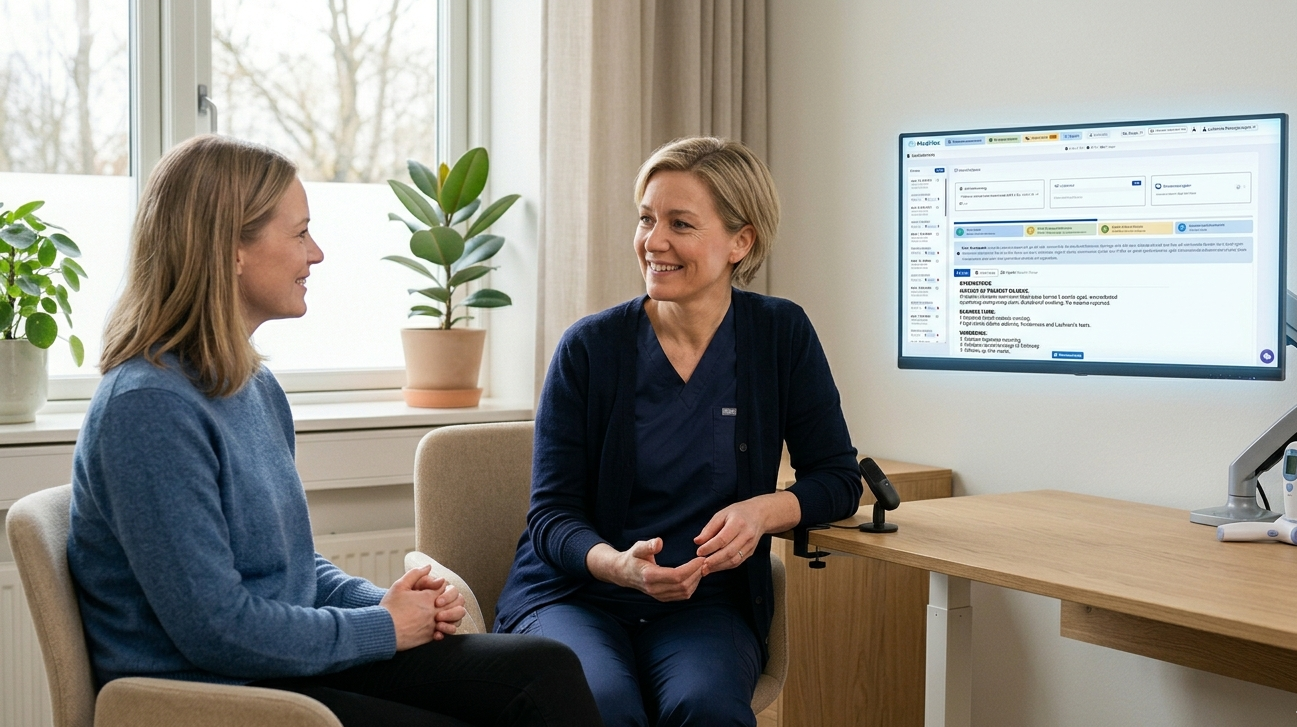
When documentation takes more time than the patient
You know the feeling: a busy day, packed schedules, and a constantly growing list of dictations that need to be transcribed. For many medical secretaries and nurses, this isn't just a task – it's a bottleneck.
Documentation is crucial for patient safety, but it takes time. In a study from the Netherlands, intensive care nurses and doctors report that documentation tasks alone can take about one hour per day.Read the study at PubMed Central).
Meanwhile, analyses from OECD and The European Commission that healthcare personnel spend a significant portion of their working hours on tasks that are not directly patient-oriented, and that there is a need to reduce administrative burdens to free up more time for patient care (see Health at a Glance: Europe: 2024).
This is the background for why more and more people are looking for solutions to automatic transcription in healthcare, dictation to text, and more efficient record-keeping.
Why manual transcription is still a time sink
Traditional transcription is not necessarily just «pen and paper» anymore. Many clinicians today use dictation tools such as integrated speech-to-text in EHRs or dedicated microphones like SpeechMike, which provide real-time transcription. These tools can certainly reduce some of the manual typing.
The problem is that real-time dictation alone often doesn't provide a fully structured journal. The text still needs editing – medical terminology must be quality assured, sentences rephrased, and the note must be structured in the correct clinical format. This means that even though transcription happens quickly, healthcare professionals still need to spend time and resources making the note ready for use.
This is why modern AI-based solutions that also understand context and clinical structure go a step further: they can not only transcribe, but also build complete medical records, dramatically reducing the total post-processing work.
«Research published in JAMA Network Open has shown that some clinical notes created using speech recognition and transcription contained errors that required post-processing to ensure correct medical content, illustrating that documentation in electronic health records can still be time-consuming for clinicians.JAMA Network Open, 2019.)
It is therefore not just a question of efficiency – it is also about quality and patient safety.
Automatic Transcription in Healthcare: A Technological Shift
Automatic transcription has evolved far beyond simple speech-to-text. Today, speech recognition is combined with artificial intelligence that understands medical language, context, and structure.
A systematic review published in Journal of the American Medical Informatics Association (JAMIA) aiming to reduce documentation time and improve workflow in clinical practice through voice recognitionStudy at JAMIA).
Recent research on generative AI also shows how clinical conversations can be directly transformed into structured medical records, reducing the need for post-processingPreprints on arXiv).
This marks a clear shift: from post-processing to real-time processing.
From dictation to finished record – in practice
What previously required multiple steps and manual effort can now happen in one continuous flow. The conversation between the healthcare provider and patient is converted to text in real-time and automatically structured as a medical record.
This does not mean that healthcare professionals lose control – quite the opposite. The role shifts from producing text to quality assuring and approving it.
Too many Does this represent a noticeable change in your daily work life?. Less time with audio files and repetitive writing, and more time for tasks that actually require professional judgment.
What does research say about quality and risk?
It is important to be nuanced. Previous studies have shown that older speech recognition systems could produce more errors and in some cases increase documentation time.Study at JAMIA).
At the same time, recent research shows that technology is developing rapidly, especially with the use of language models that improve both precision and contextual understanding.Research article on arXiv).
The point isn't that the technology is perfect – but that it has become good enough to provide real value, especially when used correctly and combined with professional quality assurance.
A more sustainable workday
When documentation happens faster, something changes in the entire work routine. Not necessarily because you have less to do, but because you have more time for what actually matters.
This is also supported by research connecting administrative burden to stress and burnout among healthcare professionalsResearch article on arXiv).
Therefore, reducing this burden is not just about efficiency – but about sustainability in healthcare.
How this relates to today's tools
If you're curious about how this actually works in practice, it might be helpful to see how such solutions are built.
Learn more about how it works in practice:
-
How does the journal generator work in Medivox How does the journal generator work?
-
More time with the patient – less time on documentation Less time on charts, more time for patients
-
Reference from chart note - stop writing everything twice Direct reference from the medical record with MediVox
The common denominator is the same: to reduce friction in everyday work.
A more natural way to get started
For many, the threshold for adopting new systems in healthcare is high. This is understandable – daily work is already complex enough.
At the same time, we see that the solutions that are actually adopted are those that require the least change to how people work. Tools that function in the background, that adapt to existing routines, and that provide value from day one.
Therefore, many choose to start by testing on a small scale. See how it works in their own consultations. Assess the quality of the notes. Get a feel for whether it actually saves time.
If you're curious about how this could work in your workday, you can explore it yourself via app.medivox.ai or participate in our webinar here, to see concrete examples in use.
The future of record-keeping is already underway
Automatic transcription is no longer a concept of the future. It is a technology that is already in use – and that is developing rapidly.
For health secretaries and nurses, it means one thing: less time on monotonous work, and more time for their profession, patients, and a smoother daily workflow.
The question is not whether this will become the standard.
The question is how quickly it is adopted.
FAQ – Frequently Asked Questions
What is automatic transcription in healthcare?
It's technology that automatically converts speech from consultations or dictations into text, often structured as finished medical records.
How much time can one save?
Studies show that documentation can take up to one hour daily for healthcare professionalsThe studyAutomation can significantly reduce some of this time.
Is it safe to use speech-to-text for journaling?
Yes, but it requires quality assurance. Modern solutions have high precision, but healthcare professionals must still approve the content.
What is the difference between old and new technology?
Older systems focused only on speech-to-text. New solutions use AI to understand context and structure entire medical records.
How do I get started?
Medivox is like using any website, you sign up at app.medivox.ai, make sure to have a good microphone (you can also order one when you sign up), read more here: How MediVox works
 English
  Norwegian