
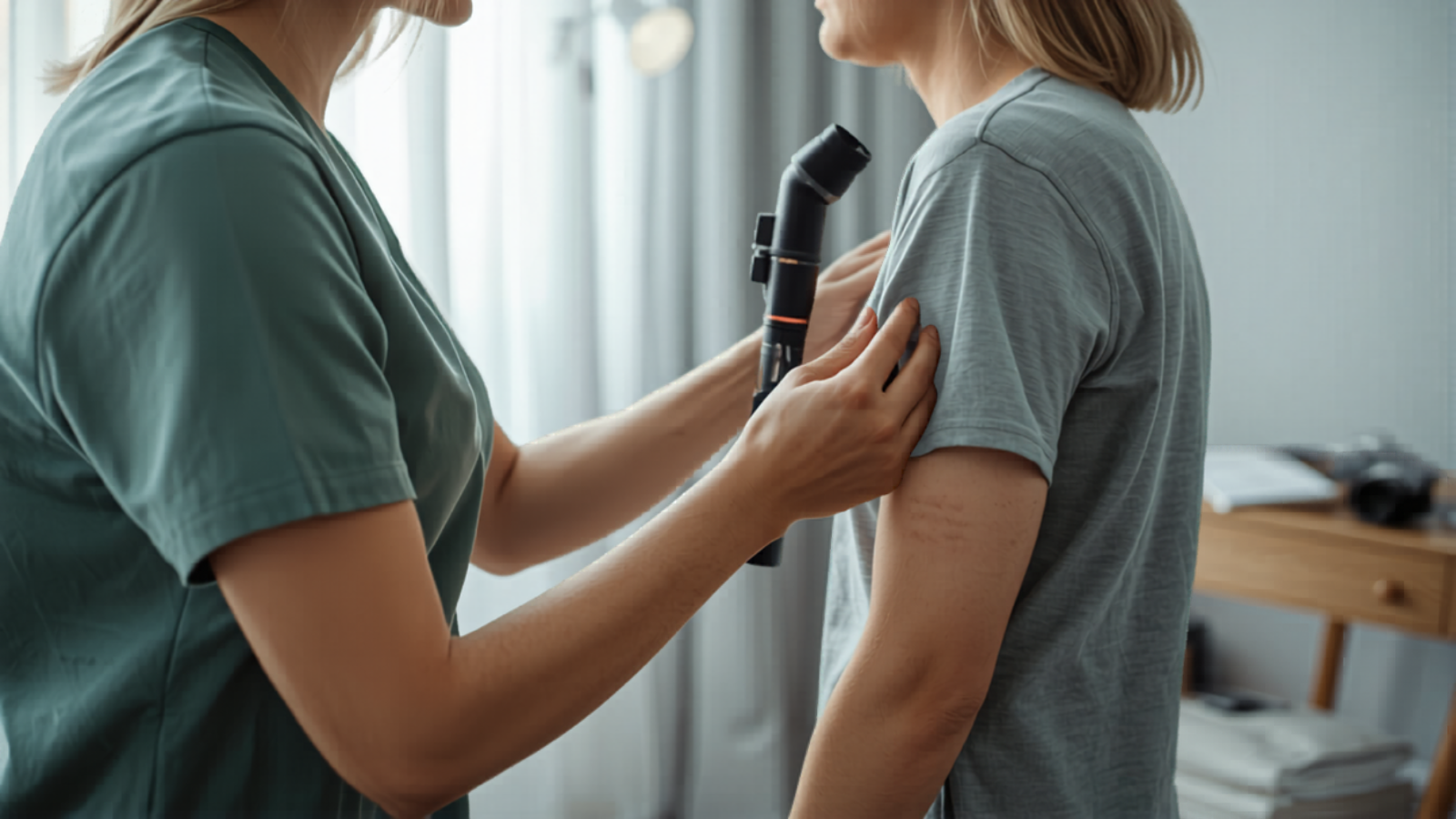
Dermatology and Medical Imaging: AI Documenting What the Eye Sees
The patient points to a lesion on their back. You observe, you measure, you take the dermoscopy image. It's 10:30, there are eight patients left before lunch – and each lesion description must be entered into the patient's chart before the next patient comes in.
Few specialties alternate so rapidly between the visual and the verbal as dermatology. The patient comes in, you see the skin the moment they take off their jacket, and part of the clinical assessment is underway before the first sentence is spoken. You examine, you photograph, you compare with dermoscopy images – and you must end up with a note that not only describes what you saw, but allows a colleague in six months to understand why you made the assessment you did.
Skin diseases are among the most frequent reasons for referral in Norwegian specialist healthcare., and specialist physicians make up a large portion of the offerings. This means high patient volumes, short consultations, and a constant stream of lesions to be assessed, documented, and potentially followed up. Documentation is not a side job in this everyday reality – it is what links the examination to the follow-up.
A skin note is a description, not a reproduction.
Much of what the ophthalmologist sees through a slit lamp and the dermatologist sees with the naked eye shares the same fundamental challenge: the visual impression must be translated into a verbal description to be recordable. We wrote about this concerning the outpatient clinic rhythm in our post about the ophthalmologist and the outpatient clinic – humor that is observed in seconds through an instrument must be kept in mind until the patient is out of the room and the note can be written.
For the dermatologist, the challenge is qualitatively different. Whereas the ophthalmologist often deals with standardized values (visual acuity, intraocular pressure), the dermatologist deals with a descriptive tradition: size, color, asymmetry, border, structure, dermatoscopic pattern. A good skin note is a form of clinical language – with fixed terms such as macula, paper, plaque, nodule, erosion, and with structured assessments following patterns such as ABCDE for pigmented lesions or dermatoscopic categories like Reticular pattern, globules, blue-white veil.
It is rare for the clinical assessment to be the problem for an experienced dermatologist. It's just that the visual impression is richer than what notes can capture. A lesion can have ten relevant characteristics; a concise note might capture four.
The image does not replace the note – it complements it
Norwegian skin clinics are increasingly using clinical photography and digital dermoscopy as part of their documentation. The images offer precision that words cannot – color, size, and pattern in a single impression – and are invaluable for tracking changes over time. Early detection is particularly important for melanoma, the most serious form of skin cancer, because the prognosis is good when the lesion is caught early – and structured photo documentation of suspicious findings is part of the clinical routine in many clinics.
But pictures don't replace the verbal note. The Patient Journal Regulations requires the journal to contain the information necessary to understand the healthcare provided – and that means a picture without a description is as incomplete as a description without a picture. The picture shows what was there; the text shows what to I see.
A well-structured skin note typically has five components:
- Medical history. How long has the lesion been there, has it changed, does it itch or bleed, and what is the patient's main concern?.
- Localization. Anatomical precision: «right scapula, paramedial» is better than «on the back.».
- Clinical description. Type of lesion, size in millimeters, color, border, texture, any secondary changes such as crusting or ulceration.
- Dermoscopic findings. Pattern, colors, asymmetry, any specific structures such as reticular network, dots, or atypical vessels.
- Assessment and plan. Differential diagnoses, whether biopsy or excision is indicated, follow-up appointment, or if the patient can be returned to their primary care physician.
It's a note structure that isn't long, but is dense. Every single component is relevant to patient safety and to what the next doctor can build upon.
When documentation becomes the bottleneck
For appointment specialists and dermatologists in outpatient clinics, speed becomes a premise in the same way as for the ophthalmologist and The ENT doctor we wrote about earlier in May. A consultation may include five to ten separate lesions, each of which is to be described, compared with previous notes, and possibly photographed. The documentation burden does not increase linearly with the number of patients—it increases with the number of lesions.
When the note is pushed out over the day, it's rarely the main finding that disappears. It's the details surrounding it: the small satellite lesion next to the main lesion, the assessment of why you chose to wait instead of biopsy, the instruction the patient received about when to return. We have previously written about what happens to the quality of record-keeping when it is shifted beyond working hours – and the dermatologist is no exception.
It is also worth remembering that the professional assessment made in the room carries greater legal weight if it is documented. If the Health Authority, the Norwegian System for Patient Compensation (NPE), or the patient later question a postponed biopsy or a lesion that later turned out to be malignant, what is written in the medical record is what counts. It's not because you thought incorrectly – it's because your line of reasoning was not documented.
How speech-to-text can support the dermatologist
A skin consultation contains a lot of verbal information that otherwise risks being left out of the medical record. What you say while examining – «right scapula, asymmetrically pigmented lesion, approx. 7 millimeters, reticular network dermoscopically, slightly irregular border» – is exactly the kind of precise description the note needs, and which often shrinks to «pigmented lesion on back, check in 3 months» when the note is written two hours later.
Medivox is built for precisely this type of verbalized examination. When you describe what you see as you do it, the description is captured in a structured draft for the progress note before the next patient comes in. Specifically, this can mean that:
- The dermatoscopic description will be included in the note with your own clinical terms
- The assessments and differential diagnoses you mention aloud are documented instead of forgotten.
- Planning, control, and patient information are clearly documented while the conversation is fresh.
- You can focus your gaze and hands on the instrument and the patient, not on the keyboard.
Patient information is kept within Norwegian data centers, and directly identifiable data is anonymized before further processing of the transcription. You make the final assessment and sign the chart – the tool ensures that what you actually said about the lesion doesn't get lost in the gap between the patient and the note.
This doesn't mean AI will take over the diagnostic assessment. It's still your eye that sees the lesion; the tool ensures that what you say about it ends up in your notes with the same precision you used in the room. our previous post on how to write a good journal entry we wrote that the best note is one that allows a colleague to understand what happened without having been there themselves. This is particularly relevant for the dermatologist: the patient may return to a colleague for a later follow-up, and the note is the only thing that links the next assessment to the first.
The quiet quality of a good skin note
A skin notation differs from many other clinical notations in that it is as much a linguistic document as a professional one. The precision of the description determines whether a change six months later is real or just a difference in phrasing. Two doctors describing the same lesion differently will appear to have seen two different patients – even if they have seen the same one.
This is the kind of precision that technology should serve. A good tool allows you to describe what you see in the room's language – with your own professional terms, your own nuances, your own assessment – and ensures it ends up in the medical record in the same form. That's what allows the dermatologist reading the note next year to build upon it, and what ensures the patient receives follow-up based on what was actually seen, not a summary written two hours too late.
Frequently Asked Questions
What must be included in a medical record note after a skin consultation?
Medical history, localization, clinical description of the lesion, any dermatoscopic findings, clinical assessment with differential diagnoses, and plan for further follow-up or patient information. The Health Personnel Act § 40 sets the requirement for relevant and necessary information; the Patient Journal Regulations provide the supplementary checklist.
Does the image replace the need for a verbal description in the journal?
No. The image and the description complement each other. The image shows what was there; the verbal description shows what the doctor saw in it, which features were emphasized, and what assessment was made.
How are dermatoscopic terms handled by speech-to-text?
A tool trained on Norwegian medical language recognizes central dermatological concepts – from lesion types such as macula and paper to dermoscopic patterns. You always do the final editing, and specialized terms you often use can be included in the clinic's own template structure.
How much time can a dermatologist save with AI-powered documentation?
Research on AI-assisted documentation in clinical practice shows that clinicians can save up to 30 minutes per day on follow-up. For a high-volume practice, this means either room for more patients or a more manageable workday – depending on your own priorities.
How is patient consent handled when both voice and image are used?
The patient must be informed about both the verbal transcription and any photo documentation, and consent should be documented in the patient record. Special rules regarding storage and use also apply to photo documentation – check the clinic's own routines and data processing agreements.
Use Medivox for free – Get started completely free
Are you a dermatologist or a specialist in dermatology and want to see how speech-to-text can fit into a visually oriented specialty? Contact us – We show you how Medivox works together with your clinical description, not instead of it.
Sources:
- Norwegian Directorate of Health Prioritization Guide – Skin Diseases
- Norwegian Directorate of Health Health Personnel Act § 40 – Requirements for journal content etc.
- Lovdata Regulation on Patient Records (Patient Records Regulation)
- Norwegian Health Service Melanoma


 English
  Norwegian