
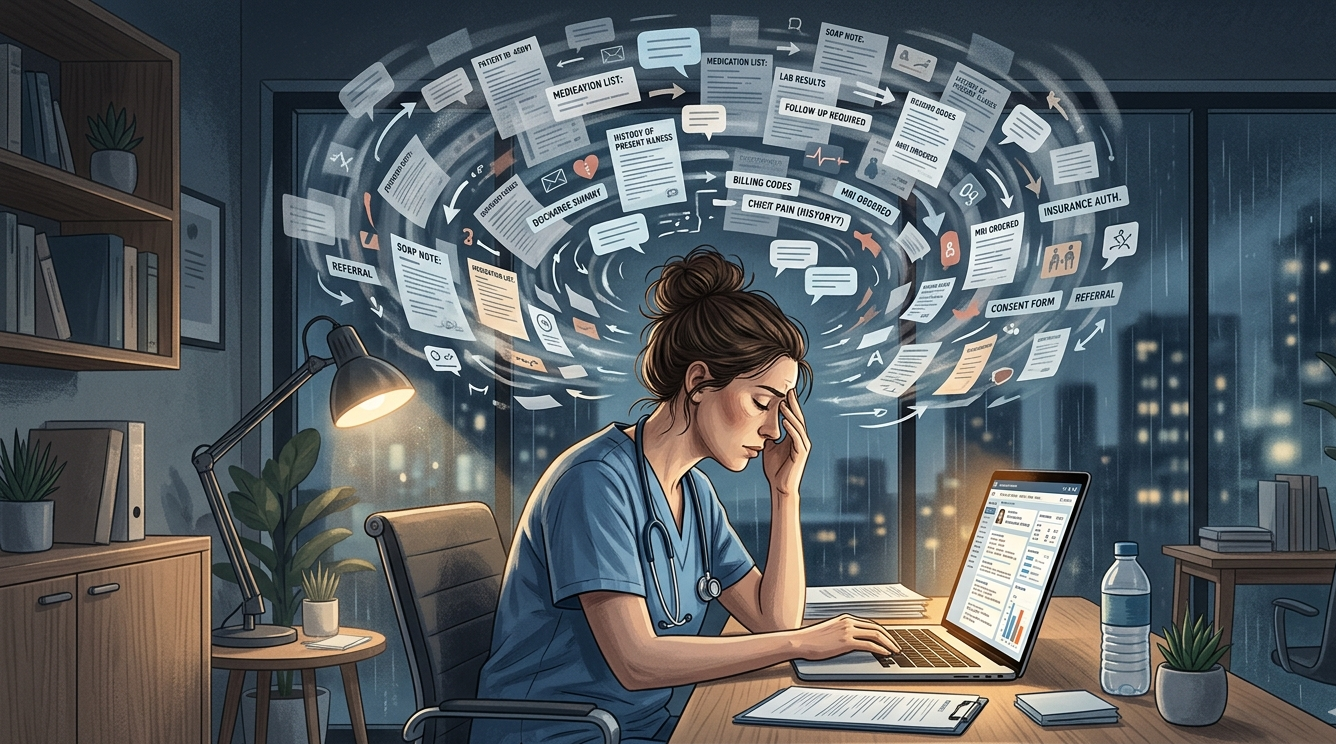
Documentation Fatigue: The Invisible Burden That Drains Healthcare Professionals
It's 5:30 PM. You've seen fourteen patients. The voices, symptoms, and concerns are all blending together into one long stream of impressions. Now you're left with a pile of unfinished patient notes – and a brain that just wants to go home.
Familiar situation?
Most healthcare professionals know that documentation takes time. There are numerous articles about time spent and many discussions about efficiency. But rarely is anything else discussed: the cognitive load that arises when documentation piles up and your head no longer cooperates.
What exactly is documentation fatigue?
Documentation fatigue isn't just about spending a long time writing. It's about the mental exhaustion that comes from having to reproduce complex clinical assessments after a long day of patient contact. Research on burnout among healthcare professionals in Norway shows that emotional demands, high workload over time, and low control are central risk factors – and documentation hits all three.Norwegian Nurses Organization).
There is a significant difference between writing a medical record at 10:15 AM – immediately after the consultation, with everything fresh in memory – and doing so at 5:45 PM, after a day full of interruptions, phone calls, and urgent requests.
When fatigue affects quality
This is where the real challenge lies. Documentation fatigue is not just uncomfortable for those experiencing it – it's a real risk to patient safety.
A doctor documenting seven consultations at the end of the day does so with a brain that is already overloaded. Details slip. Nuances disappear. Medical records written under time pressure and cognitive exhaustion often become shorter, more generic, and less precise than they should be.
In an article on Sykepleien, the author points out that some healthcare professionals postpone documentation until the next day to avoid overtime – with phrases like «I'll document tomorrow, so there won't be overtime.»NursingThis is understandable, but problematic: the longer the time between patient encounter and documentation, the greater the chance that important information will be lost.
The problem isn't the will, it's the capacity
Let's be clear: healthcare professionals struggling with documentation are not lazy or unprofessional. The Health Personnel Commission stated in NOU 2023:4 «Time for Action» that the health and care services cannot expect significantly more staff in the years ahead.The governmentThis means that those already in employment have to handle an ever-increasing number of tasks – including increased documentation requirements.
The Journal of the Norwegian Medical Association has documented that hospital doctors spend only 46 percent of their workday on direct patient contact, down from 54 percent at the turn of the millennium (The journalThe rest goes to administrative work, meetings, and – not least – documentation. When the workday is already packed, the final medical records become victims of exhaustion.
What if documentation could happen along the way?
Imagine the following scenario: You are conducting a consultation with a patient who has complex complaints. Instead of taking brief notes and finishing the record later, the conversation is automatically captured. After the consultation, you have a fully structured medical record ready – based on what was actually said.
This is precisely it Medivox using AI-powered speech-to-text during the consultation moves documentation from the end of the day to the moment the information is fresh and complete. You won't have to reconstruct conversations from memory after fourteen patient encounters.
Try Medivox for free and experience the difference yourself →
From Reconstruction to Real-Time
The traditional approach to record-keeping is, in practice, an exercise in retrospective reconstruction. You try to recreate what happened – what the patient said, what you assessed, what interventions you decided upon – long after it actually happened.
Medivox turns this on its head. The system records and transcribes the consultation in real-time, using advanced AI to generate a structured medical record that you can then review and edit. Instead of using cognitive capacity to remember and formulate, you can use it for what truly requires professional judgment: assessing whether the note is correct and complete.
The Directorate of Health's report on digitalization in health and care services from 2024 shows that healthcare personnel are already seeing positive effects of digital tools in their documentation work.Directorate of HealthMedivox takes this a step further by removing the writing itself from the equation.
It's not just about time – it's about health
Studies show that burnout among healthcare professionals consists of three dimensions: exhaustion, cynicism, and reduced professional efficacy.The Norwegian Medical AssociationDocumentation fatigue affects all three. You get exhausted by the volume, you distance yourself from the clinical content to get through the pile, and you feel like the notes don't reflect the work you actually did.
Reducing the documentation burden is therefore not just a matter of efficiency. It is a workplace environment measure. When you no longer have to stay late alone with your screen after the workday, you don't just free up time – you free up mental capacity that you can use for patients, colleagues, or simply to recharge.
Three signs that documentation fatigue is affecting your workday
Not sure if this applies to you? Here are three common signs:
- You systematically postpone journaling not because you forget it, but because you can't be bothered to start.
- Your notes are getting shorter throughout the day – the first patients get thorough notes, the last ones get minimum versions.
- You feel uneasy about the quality - you know that the notes don't always reflect the clinical picture well enough, but you don't have the capacity to do better.
If you recognize yourself in one or more of these points, it's worth considering if your work tools are actually supporting you well enough.
Frequently Asked Questions
What is documentation fatigue?
Documentation fatigue is the cognitive and mental exhaustion that occurs when healthcare professionals have to document large amounts of clinical information after prolonged patient contact. It affects both the quality of the documentation and the employee's well-being.
Can speech-to-text really reduce cognitive load?
Yes. By capturing information in real-time during the consultation, you avoid reconstructing conversations from memory. This significantly reduces the cognitive workload associated with documentation.
Is Medivox safe to use with patient data?
Medivox has been developed with a focus on privacy and security, and meets the requirements of GDPR and Norwegian health legislation. Read more about Privacy and security at Medivox.
Take control of documentation fatigue
Documentation fatigue is not something you have to live with. There are tools designed to meet this exact challenge – tools that allow you to document while the information is fresh, without sacrificing your evening or quality.
Want to see how it works in practice? Book a free demo of Medivox and experience how AI-driven journaling can change your workday.
Sources:
- Norwegian Nurses Organization – Facts about the nurses' working environment
- Nursing - Do your duty: Grab your keyboard and write
- White Paper 2023:4 Time for action – The Government
- The Journal – Many doctors are working more than before
- Norwegian Directorate of Health – Health Personnel Survey 2024
- The Norwegian Medical Association/LEFO – PhD on Burnout


 English
  Norwegian