
Hands Don't Document: The Physiotherapist's Unique Documentation Challenge
You feel it in your hands – the shoulder that finally gives in, the mobility that returns. But the journaling system doesn't see what you feel. It wants text.
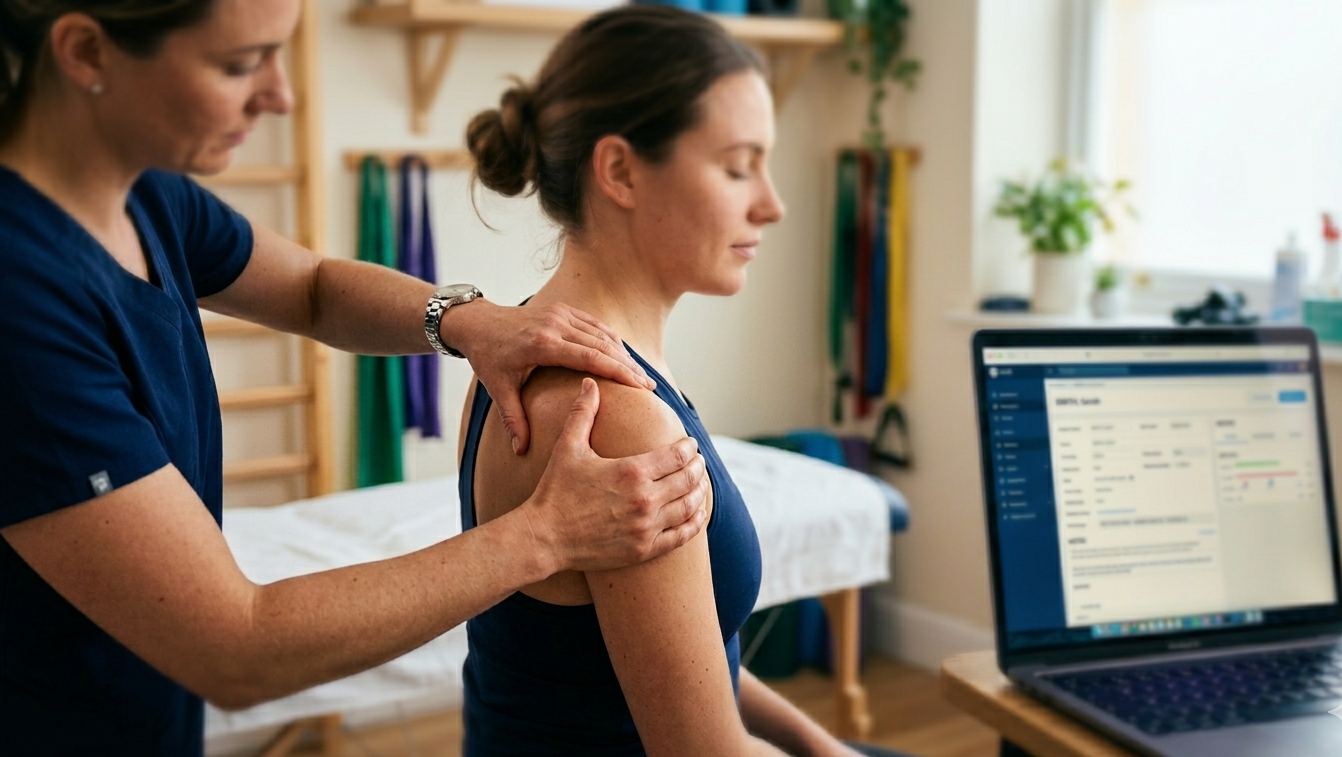
There is something fundamentally different about being a physical therapist compared to most other healthcare professions. Your work is physical. You observe gait patterns, palpate tissues, mobilize joints, and guide movements. The most important assessments you make during a treatment session happen through your hands and eyes—not through a keyboard.
But when the treatment is over, the EHR system awaits. And it doesn't understand hands.
What makes the physical therapist's documentation situation unique is not just amount — that's the translation problem. You have to take something you've experienced physically and turn it into structured text. Shoulder range of motion, lumbar muscle tone, the quality of a movement pattern. And you have to do it within a ICF framework that requires precision about function, activity, and participation — not just symptoms.
New digital demands meet an old reality
For physiotherapists in Norway, 2025–2026 is a turning point. Through EPJ promise The Directorate of Health is investing 3 million kroner to strengthen the electronic health record systems for physiotherapists and manual therapists. The measures range from improved task control and digital patient communication to simpler Annex 2 reporting to Helfo.
Perhaps the most significant thing is that physiotherapists and manual therapists now access the core journal. This gives you an overview of the patient's medications, allergies, and critical information—right in the treatment situation. The needs assessment was completed in early 2026, and procurement is planned.
All of this is positive. But it also means that the digital surface is growing. More access entails more expectation to contribute digitally. For a professional group already commuting between the treatment table and the keyboard, timing is important: the digital tools must help with documentation, not just add new tasks.
What you do with your hands, put it in text
A general practitioner can dictate while the patient is sitting in the chair. A psychologist can take notes between sentences. But as a physical therapist, your hands are busy. You demonstrate an exercise, correct a posture, provide resistance in a joint. You can't write at the same time – and often you can't even stop to take notes.
As a result, most physiotherapists document afterwards. From memory. And that's where the information leaks out.
How many degrees did the mobility increase? What did the patient say when you tested their strength? Which exercises were performed, and how did the patient respond? After four or five treatments in a row, the details blur together. Journal Regulation requires that examination results — including diagnosis and treatment goals — be documented. The functional assessment that triggers specific fees must be in writing. There is no room for «approximately.».
Internationally, the figures confirm the pressure. fresh survey from the American Physical Therapy Association (APTA) aiming to 91 % av fysioterapeuter administrative burden contributes to burnout. Nearly half reported burnout in 2025, with documentation identified as one of the primary single causes. The figures are American, but the translation problem—from hands to text—is universal.
Research on AI in rehabilitation: promising, but early
The effectiveness of AI documentation for general practitioners is well-documented. But what about rehabilitation professions? study published in JMIR in 2025 just investigated this — the effect of generative AI on clinical documentation among physical therapists, occupational therapists, and speech-language pathologists. Twelve rehabilitation professionals participated in the study, where they compared conventional documentation with AI-assisted documentation.
The findings were nuanced. The AI tool was found to be useful, but the time savings were not statistically significant in this early phase. The researchers pointed to a key reason: the rehabilitation domain has specialized terminology and workflows that require customized models. Generic AI tools do not necessarily understand the difference between passive and active range of motion, or the nuances of a functional assessment according to the ICF.
That doesn't mean technology is irrelevant to physiotherapists. It means the tool must understand the context. And it means that what sure During treatment—instructions, observations, the conversation about pain and function—is a valuable starting point that manual follow-up documentation can never match.
The conversations you already have
Here's the point often overlooked in discussions about physiotherapy and documentation: you are not silent while you work. Throughout the entire treatment, you talk to the patient. «Do you feel that stretching here?» «Try to lift your arm a little higher.» «Last time you managed ten repetitions—now let's do twelve.» «The pain you described last session, is it better now?»
This conversation contains much of what should go into the journal — goals, measures, responses, progress. The problem is that no one is capturing it. Until now.
Medivox transcribes the conversation between you and the patient during treatment. Afterward, you will receive a draft of the medical record that you can review and adjust—instead of reconstructing everything from scratch. You decide what is clinically relevant, what should be rephrased, and what should be omitted. But the starting point is what was actually said, not what you remember saying.
For a professional group discussing sensitive health conditions during hands-on treatment, privacy is crucial. The patient's name is replaced with a fictitious name before anything is processed by the AI, and all data processing takes place at Norwegian data centers. More about how pseudonymization works and Privacy at Medivox.
From translation to review
The core of the physical therapist's documentation problem is that it is a translation work. You translate from body to text, from hands to keyboard, from a dynamic treatment situation to a static journal entry. It takes time, it requires concentration, and it happens at a time when you are often tired after a day of physical work.
When the documentation starts with the conversation itself—what you said, what the patient responded, the instructions you gave—the task changes character. From translation to review. From a blank form to a draft. It's a difference that makes a difference, especially in a daily routine where the EHR promise, core journal, and new digital demands are raising expectations for what the physical therapist should deliver digitally.
We have previously written about how psychologists encounter similar challenges with their therapy notes — and about how general practitioners have already transitioned to speech-to-text. Physiotherapists have their own unique challenges. But the solution starts in the same place: with the conversation that is already happening.
Frequently Asked Questions
Does an AI tool understand physiotherapy terminology such as ICF codes and functional assessments?
AI tools are rapidly developing for the rehabilitation field. Medivox transcribes what is said in the conversation and creates a draft you can edit. You add the clinical assessments and codes yourself — but you don't have to write everything from scratch.
My hands are busy during treatment — how does that work in practice?
Medivox listens to the conversation already happening between you and the patient. You don't need to do anything extra during treatment. Afterwards, you will receive a draft based on what was said.
What is the EHR promise, and what does it mean for physical therapists?
The EPJ-løftet is a national program from the Norwegian Directorate of Health that invests in better electronic health record systems for physical therapists and manual therapists. In 2025–2026, work is being done on core record access, digital dialogue with patients, task control, and simplified Appendix 2 reporting to Helfo.
Is it safe to transcribe conversations during physical therapy?
All patient data is pseudonymized — the patient's name is replaced with a fictitious name before the AI processes anything. All data processing takes place in Norwegian data centers. No data is sent out of Norway.
Can I try Medivox without commitment?
Yes, you can test Medivox completely free of charge with no commitment. You will get full access to try the tool in your own practice.
Try Medivox for free – Start your free trial
Are you a physical therapist looking for ways voice-to-text can fit into a treatment environment where your hands are occupied? Contact us We'd be happy to show you how it works in practice.
Sources:
- The Directorate of Health (2025–2026): EPJ promise for physical and manual therapists
- Physiotherapist: More people gain access to the core journal
- Physiotherapist: ICF – A Common Language for Function
- Lovdata Regulation on functional and quality requirements for physiotherapists with municipal service agreements
- APTA (2025): The Impact of Administrative Burden on Physical Therapist Services
- APTA (2025): Survey Findings Drive New APTA Advocacy Resources on Administrative Burden
- Nishimura, T. et al. (2025): Effects of Introducing Generative AI in Rehabilitation Clinical Documentation, JMIR

 English
  Norwegian