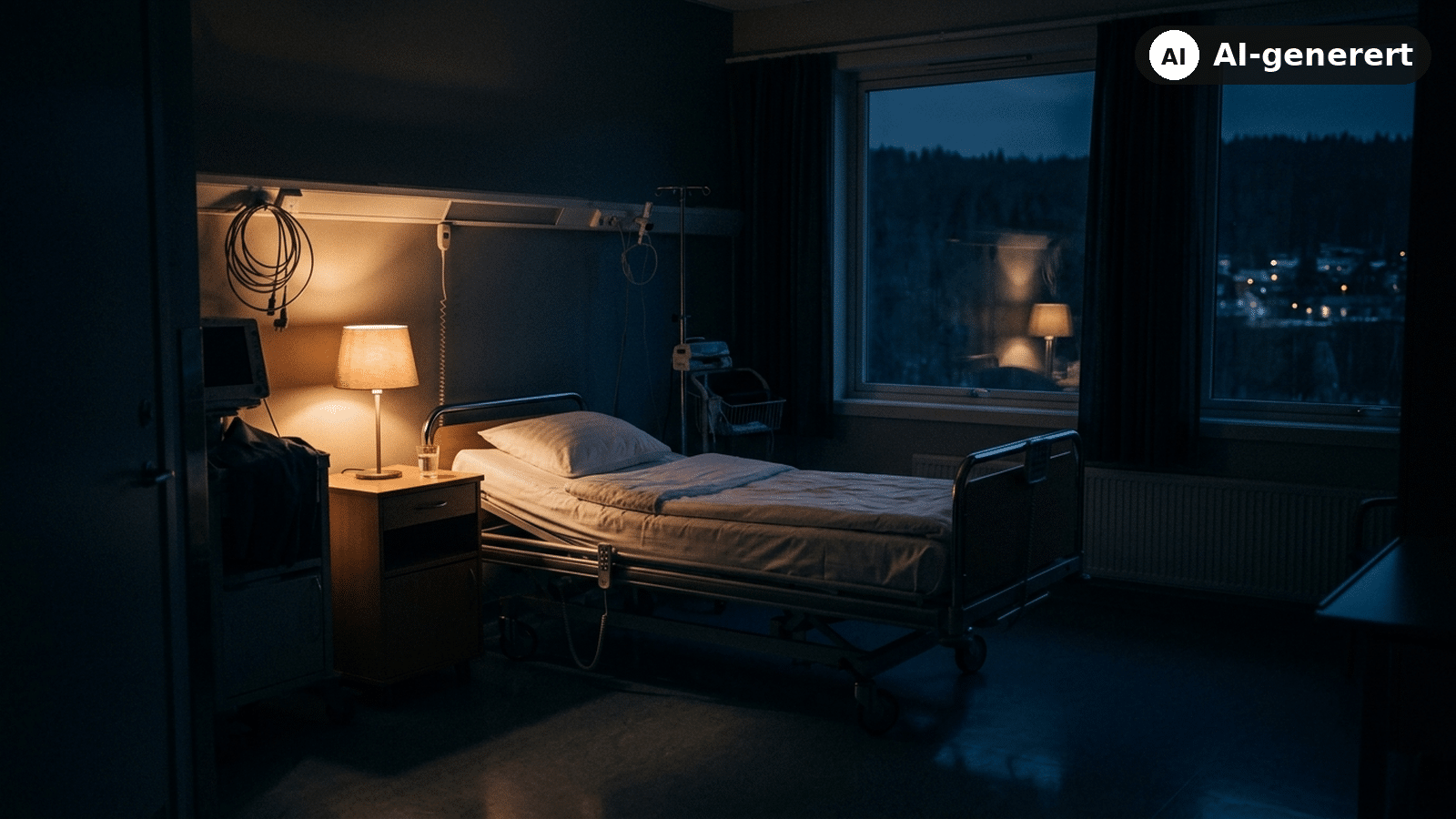
The graph shows what happened hour by hour. But it does not tell why — and it is the «why» that should be present when the patient is transferred on to another treatment.
Half past seven in the morning. The patient who came in last night is stable enough to be moved to a bed post during the day. You have been there all night. You know which two hours were critical, why the dose was changed at three o'clock, what was tried and rejected, and how she reacted when she woke up.
The nurse who greets her on the third floor knows nothing about this — except what you wrote down before nine o'clock.
A short stay does not mean a single stay
Norwegian intensive care register recorded 19,250 intensive care stays distributed among 15,185 patients in 2025. In total, there were 70,236 intensive day stays, and the median time is short: 2.0 days. Respirator support was given in half of the stays, and medications to support blood pressure and circulation were used in nearly two-thirds, according to the annual report for 2025.
The numbers say something about what kind of documentation task this is. Two days is a short time to get to know a patient, and a long time for the condition to change several times. Everything is recorded continuously — values, doses, interventions — but the continuous recording is not the same as a presentation that someone else can read.
Patient record regulation § 4 formulates the difference precisely: the journal should provide an clear and comprehensive recording the patient's condition so that healthcare professionals can easily understand it and plan further care accordingly. In an intensive care unit, there is no shortage of data; it is the compilation of the data that is the work.
The quality indicator that has not been reached since 2022
The Norwegian Intensive Care Register measures whether the units routinely have a completed note with relevant information and a summary of the stay available upon discharge — including an updated medication list that is readily accessible to the receiving unit.
In 2025, the result was 80.6 percent Nationally. The target is at least 90. The registry itself writes that there has not been a national goal achievement since 2022, pointing to a likely explanation: the registry has grown with new member units, especially monitoring and postoperative units, where the routine for a summary note upon transfer to a bedside unit has to a lesser extent been established. The traditional intensive care units, both in small and large hospitals, mainly meet the indicator.
In other words: the number is less about someone stopping to write, and more about the fact that the requirement now applies to more types of devices than before. The registry encourages member organizations to establish a routine for printing notes as well. short staying, because these patients are often complex, and because an updated, summary note is what the receiving department needs — especially if the patient has to return to intensive care later in the same course of illness.
The same report shows that daily multidisciplinary review of patients is routine in 86.6 percent of the units, even under the target of 90 percent. Both indicators really deal with the same thing: that there is a common, expressed image of the patient that more than one person knows.
What an admission note from the intensive care unit should contain
It is not the curve that needs to be repeated. What the receiver needs are the things that cannot be read from the numbers:
- What happened, and why. The course of events in brief form, with the reasons behind the most important decisions. Patient record regulation § 6 explicitly mentions that considerations that have led to actions that deviate from applicable guidelines should be stated.
- Updated medication list. There is an explicit requirement in the quality indicator, and this is often where the most changes have occurred during the stay. We have written about why this is more difficult than it seems in the post about Clinical pharmaceutical and drug compliance.
- What was tried and did not work. Negative information is easy to omit and expensive to lack.
- What should be followed up on next. Specifically: what signs, what threshold, who should be contacted.
- What the patient and their relatives have learned. Many people remember little about the actual stay. What is communicated along the way is often communicated to someone other than the patient.
The transition between two units is a known vulnerable point in the entire healthcare system, not only in intensive care. We have described the same challenge from the ambulance side in the post about the documentation after the assignment.
The Medivox fits in
The problem is rarely that someone doesn’t know what should be included in a discharge note. The problem is that it needs to be written during the busiest hour of the shift, by someone who has been awake for eleven hours, while a new patient is on the way in.
Medivox is a dictation tool. You speak through the summary — preferably while you are tidying up the bed — and get a draft of the note in a template you have created yourself. For an intensity of this kind, the template can contain exactly those fixed points above, so that memory or excess is not the determining factor in whether the medication list and the justifications were included.
Some clarifications: transcription and generation are done by an AI service from OpenAI, and the processing takes place in the EU. Patient data is stored on our own servers in Norway, and the information is pseudonymized before the data is further processed. Medivox does not make any clinical assessments and has no decision support — the tool documents the assessment you have already made. You own the journal and make the final assessment. And we make no claims about how your journal system is built; where the note is to be entered is best decided by you yourselves.
What remains after two days
The patient is unlikely to remember you. Many people remember little or nothing from an intensive care stay. What remains after the two days is a person who is a little better — and a note.
The note is the only part of your work that continues to follow her upstairs. How long does it actually take at your company from the decision to transfer to the note being finished — and who writes it?
Frequently Asked Questions
What should be included in an admission note from the intensive care unit?
A brief summary of the course of the treatment, with justifications for the most important decisions, updated medication list, what has been tried without effect, what should be observed further, and what the patient and their family have been informed about.
How many intensive stays are there in Norway per year?
The Norwegian Intensive Care Register recorded 19,250 stays for 15,185 patients in 2025, with a median length of stay of 2.0 days.
Why is the printout note a separate quality indicator?
Because the transition from intensive care to the hospital bed is a vulnerable point. The indicator measures whether the unit has a routine for ensuring that a completed note with updated medication lists is available upon discharge. The national result in 2025 was 80.6 percent, compared to a requirement of at least 90 percent.
Does dictation work in an intensive care unit?
Dictation is the core function of Medivox, and you create the templates yourself. The usefulness is greatest when the same type of note is written frequently and under time pressure — such as during transfer.
Does a dictation tool replace the interdisciplinary review?
No. The review is a professional conversation between people. A writing tool can only make it easier to get the conclusion from that conversation written down while it is fresh.
Use Medivox for free – Get started completely free
If you work somewhere where the timesheet is often filled out overtime, we would be happy to hear how you have tried to solve the problem. Contact us – We are happy to show you how to build your own templates.
Sources:
- Norwegian intensive care and crisis registry (2026): Annual report for 2025 with plan for improvement measures
- Helse Bergen HF: Norwegian Intensive Registry (NIR)
- Lovdata Regulations on patient records (the patient record regulations) § 4 to § 8
Related posts
30,000 people need to switch their insulin – this must be recorded in the medical records
October 3, 2026

The treatment will last for this year. The journal must keep going for the same length of time.
October 1, 2026

Three lines about interpreters who are often missing from the journal
September 29, 2026
Share