
The patient you have never met before – the medical record note at the emergency room
At the emergency clinic, every consultation starts from zero. The note you write is often the only thing others get to know about what happened.
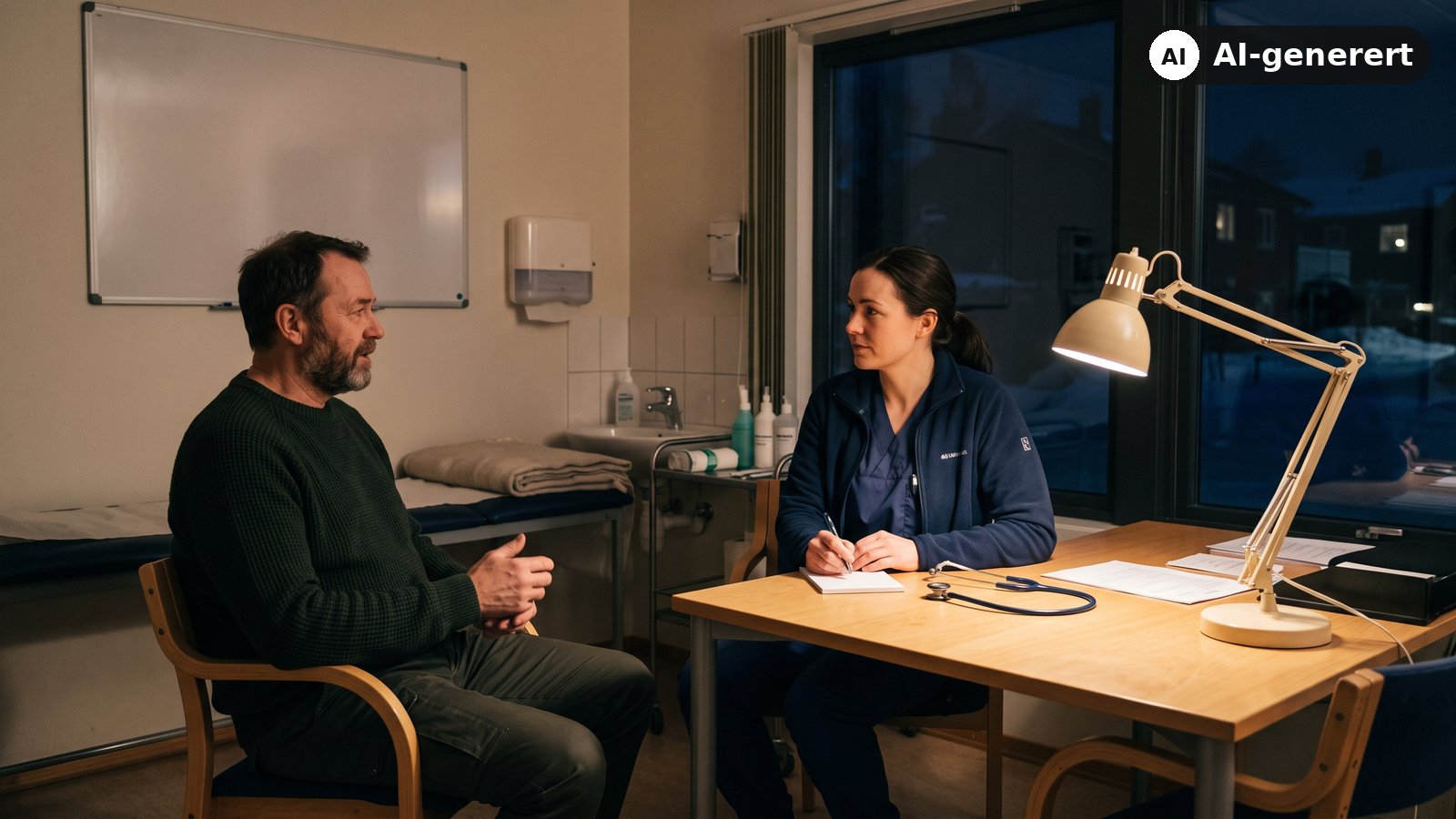
It is a quarter past two in the morning. The patient on the examination table is someone you have never seen before, and will probably never see again. You don't know the background, how the person usually appears, or what the primary care physician has tried. You have what the patient tells you, what you observe yourself, and what you manage to gather during a consultation that has to move quickly – because there are four more waiting in the waiting room.
That is how you write the note. And that note must work for someone you don't know who is: the GP reading it on Monday, the hospital doctor receiving the patient six hours later, or a supervisory case in two years. It is a documentation situation unlike almost any other in the health service.
The memo that must stand on its own two feet
In a standard follow-up relationship, the medical record carries context over time. In emergency out-patient care, that context does not exist. The note must therefore contain both what you found and why you landed on your conclusion—without being able to rely on anything written further up in the record.
The requirement itself is the same as everywhere else: you must record relevant and necessary information about the patient and the healthcare provided, and the medical record must be easy for other qualified healthcare personnel to understand. The Norwegian Directorate of Health's guideline for emergency primary care is clear that this includes the emergency room physician, other emergency room personnel, and the emergency room operator's documentation of healthcare, medical advice, and notes following all register patient contacts – including telephone advice that never results in a physical consultation.
The pressure lies in the fact that the requirements for what the note must contain increase precisely in those situations where you have the least time. The Directorate of Health points out that the documentation requirement increases if you choose a treatment that deviates from current guidelines – and the emergency clinic is precisely the place where you often have to improvise around a patient who does not fit into an algorithm. The Norwegian Board of Health Personnel has repeatedly ruled that bullet-point-style, extremely brief medical records lacking structure and coherence violate Section 40 of the Health Personnel Act. The note you wrote in ninety seconds at two in the morning may be measured against that standard.
The decision to not do something
What is hardest to document at the out-of-hours clinic is often what you decided to leave undone. The patient you sent home with instructions to return if they worsened. The chest pain you assessed as muscular. The child you thought could wait until the GP's office opened.
In retrospect, it is not the action that is asked for – it is the reasoning. What was it that you saw that made you land there? Which red flags were you looking for and failed to find? What did you tell the patient about when they should return? This is information that is clearly present in your head the moment you are in the room, and which fades quickly when the next patient enters. We have written about the same phenomenon in another part of the emergency chain – the ambulance worker who must document the assignment after treatment has been given – and the mechanism is the same: the greater the distance between the event and the record, the more detail disappears.
The emergency clinic also has an infrastructural starting point that makes documentation more important than many realize. After the Emergency Medicine Regulations – last amended with effect from 1 January 2026 – the emergency medical dispatch center shall keep an audio log of important traffic, and the recordings shall as a general rule be stored for three years because they have value as documentation. The call to the emergency ward is thus documented. Then what happens in the examination room should be as well.
The Medivox fits in
Medivox is built for that exact distance between consultation and note. You dictate while the assessment is fresh – ideally right after the patient has walked out the door, while you still remember what the skin looked like and what they actually said about the onset of pain. You get a structured draft back, which you edit and approve before it goes into the patient record. Dictation is the core of the tool; the point is not for you to write less, but to avoid having to type at all. later.
For the emergency room, that means two things in particular. One is that negative findings and reasoning actually get included – it is faster to say «no neck stiffness, no petechiae, informed to return in case of fever over 39 or reduced general condition» than to type it. The other is that you can build your own templates for the situations that recur on duty: chest pain, head injury, urinary tract infection, telephone consultation. The templates are yours, adapted to the way your out-of-hours clinic works.
Privacy is a premise, not an add-on. Directly identifiable information is pseudonymized before further data processing, and all data processing takes place in Norwegian data centers. And it is worth stating clearly: Medivox documents healthcare—the tool makes no medical assessment. You own the patient record and make the final assessment.
One perspective: documentation as mutual protection
It is easy to think of thorough medical record-keeping at an out-of-hours clinic as something that primarily protects you. It does that too. But the most important effect is that the patient avoids having to retell their entire story to the next practitioner – and that the primary care physician who reads the note on Monday morning can actually build upon what you did, instead of starting from scratch.
The emergency clinic is a service where many professional groups meet across disciplines: on-call doctors, emergency dispatch nurses, medical secretaries, and ambulance personnel. Everyone documents in the same patient record. When documentation takes less time, it results in both more energy for the patient in front of you – and a clearer path for the person taking over.
Frequently Asked Questions
Does speech-to-text work in a busy emergency room with background noise?
Yes, but the result is best when you dictate in the examination room or on-call room rather than in the middle of a hallway. You always edit the draft before it goes into the medical record.
How do I best document a patient I don't know beforehand?
Be explicit about what you actually know and where the information comes from, include relevant negative findings, and write down what you have informed the patient about—especially when the person is going home without further measures.
Does Medivox require integration with the out-of-hours clinic's EHR system?
No. You get a finished draft that you quality assure and enter into the electronic health record system the emergency clinic already uses.
Is it safe to use speech-to-text when patient information is sensitive?
Directly identifiable information is pseudonymized before the data is processed further, and all data processing takes place in Norwegian data centers.
Can the tool help me with the actual assessment of the patient?
No. Medivox documents the conversation and the healthcare provided. The clinical assessment is and remains yours.
Use Medivox for free – Get started completely free
Do you work shifts and recognize the stack of unwritten notes at the end of the evening? Contact us – then we will show you how a draft takes shape while the assessment is still fresh.
Sources:
- The Norwegian Directorate of Health (2025): Emergency clinic and emergency medical communication center – organization of the emergency clinic system
- The Directorate of Health (2026): Health Personnel Act with comments – Section 40 Requirements for the content of the medical record, etc.
- Ministry of Health and Care Services (2015): Regulations relating to requirements for and organization of the municipal out-of-hours medical service, ambulance service, medical emergency communication service, etc. (the Emergency Medicine Regulations)
- Ministry of Health and Care Services (2019): Regulation on Patient Records (Patient Records Regulation)


 English
  Norwegian