
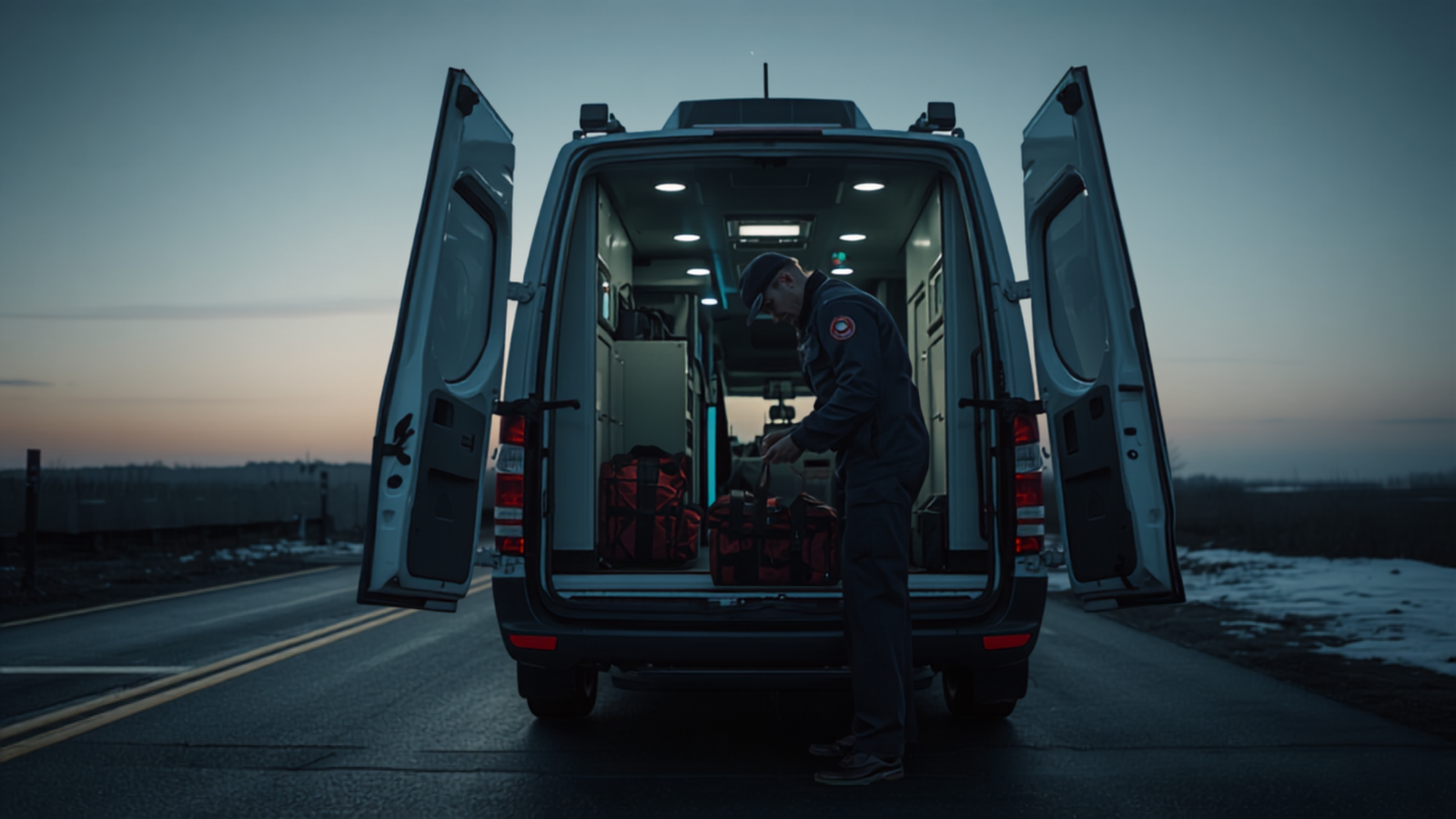
The ambulance worker and the post-assignment documentation: When treatment happens before the note
You treat the patient in the car. You write the medical record afterwards – often from memory, while the next emergency response may already be on the way.
The time is 03:20. You have picked up a patient with chest pain, performed an ECG, administered medication, and notified the dispatch center en route. Upon arrival at the hospital, you give a verbal handover to the emergency department – and then all of this has to become a prehospital medical record. Times, measurements, interventions, response. Much of it happened while the ambulance was in motion and your hands were busy with the patient, not a keyboard.
As an ambulance worker, you authorized healthcare professional, and after the Emergency Medicine Regulations Ambulances should as a rule be staffed by at least two people, where at least one is authorized as an ambulance worker or paramedic. That competence also entails a duty to document – and the pre-hospital patient record is one of the most demanding to keep well, simply because working conditions rarely allow for writing while things are happening.
An entire mission must be captured in retrospect
An ambulance mission is a chain of timestamped events. When did you arrive, when did treatment begin, when was the medication administered, how did the patient's condition change? This information is crucial for those who take over—the emergency department, the on-call physician, and subsequent healthcare providers who read the course of events. A pre-hospital patient record that lacks a timestamp or a response makes it more difficult for the next link in the chain to make good decisions.
The problem is well known: much of this has to be reconstructed after the patient is handed over. You remember that you gave pain relief, but was it before or after the second blood pressure measurement? Did the patient say the chest pain radiated to the left arm, or was it the jaw? Such details are precisely what the medical record is supposed to capture accurately—and they are also what fades the fastest when the note is written half an hour later, perhaps after a new assignment has intervened.
The duty to document applies – even in the emergency department
The journal must, according to the Health Personnel Act, contain relevant and necessary information about the patient and the health care, and it must be readable and understandable by other qualified healthcare personnel. For the prehospital service, this is a high threshold: the patient record must both document the clinical course and serve as the foundation upon which the receiving facility builds. At the same time, writing always competes with the next task.
Prehospital service is additionally a field in professional development. The introduction of authorization as a paramedic has raised the competence requirements in the service – and with higher competence often comes more advanced treatment that must be documented. Nevertheless, ambulance workers are rarely mentioned when The digitalization of healthcare is being discussed; the tools are usually built for the office, not for the back seat of an ambulance.
This is how Medivox can be part of the solution
Medivox listening to what you say and delivering a structured draft of a patient record. In a pre-hospital context, this means you can talk your way through the course of events – «patient found awake, clammy and pale, initial blood pressure 90 over 60, given oxygen, ECG shows...» – and get it back as a neat draft instead of having to write everything from memory afterwards. The tool runs in the browser and requires no heavy hardware.
Because you build your own templates, the structure can mirror a pre-hospital workflow: incident and on-scene findings, vital signs, interventions with timestamps, response, and handover. This makes the note easier to complete after a mission—and easier for the receiving end to read. Privacy is protected: personal data is pseudonymized before the data is processed further—we have explained how pseudonymization works in a separate post – and all data processing takes place in Norwegian data centers. The responsibility is yours all the way: You own the medical record and make the final assessment. Medivox creates the draft; the clinical assessments and priorities are yours.
Time that can be returned to the patient
Ambulance workers operate in a service where minutes count and post-work often eats into the time between assignments – or into rest breaks. When the patient record can be built from what you actually said during and right after the assignment, there is less to reconstruct and less risk that an important time or observation will be left out. This is not about documenting more, but about documenting what happened while it is still fresh.
Perhaps that is where the real gain lies: not in removing the documentation, but in moving it closer to the event it describes. What would it mean for the quality of your medical record if you could capture the course of events while it is still in the body?
Frequently Asked Questions
Does speech-to-text work for prehospital documentation?
Yes. You can build your own templates for events, vital signs, interventions with time, response, and handoff, so that the draft follows a pre-hospital workflow.
Can I document right after an assignment while the details are fresh?
Yes. Medivox runs in the browser, so you can talk through the case as soon as the patient is handed over, instead of writing everything from memory later.
Does Medivox replace my clinical assessments?
No. Medivox creates a draft based on what is said. You own the medical record and make the final assessment; the clinical decisions are yours.
Are the patient details safe?
Personal data is pseudonymized before it is processed further, and all data processing takes place at Norwegian data centers.
Is the tool suitable for a fast-paced service?
The goal is to reduce rework by capturing the course of events early. A structured draft is faster to complete than an empty chart field after a busy night.
Use Medivox for free – Get started completely free
Curious about how speech-to-text can fit into a busy pre-hospital daily life? Contact us – We'll show you how Medivox works with your templates and your workflow.
Sources:
- Norwegian Directorate of Health Duty to document (Health Personnel Act with commentaries)
- Lovdata Regulations on requirements for and organization of the municipal out-of-hours primary care service, ambulance service, etc. (the Emergency Medical Services Regulations)
- Lovdata The Health Personnel Act (Health Personnel Act) Section 39 – Obligation to keep medical records
- Norwegian Directorate of Health Paramedic – transitional arrangement for ambulance workers and nurses


 English
  Norwegian