
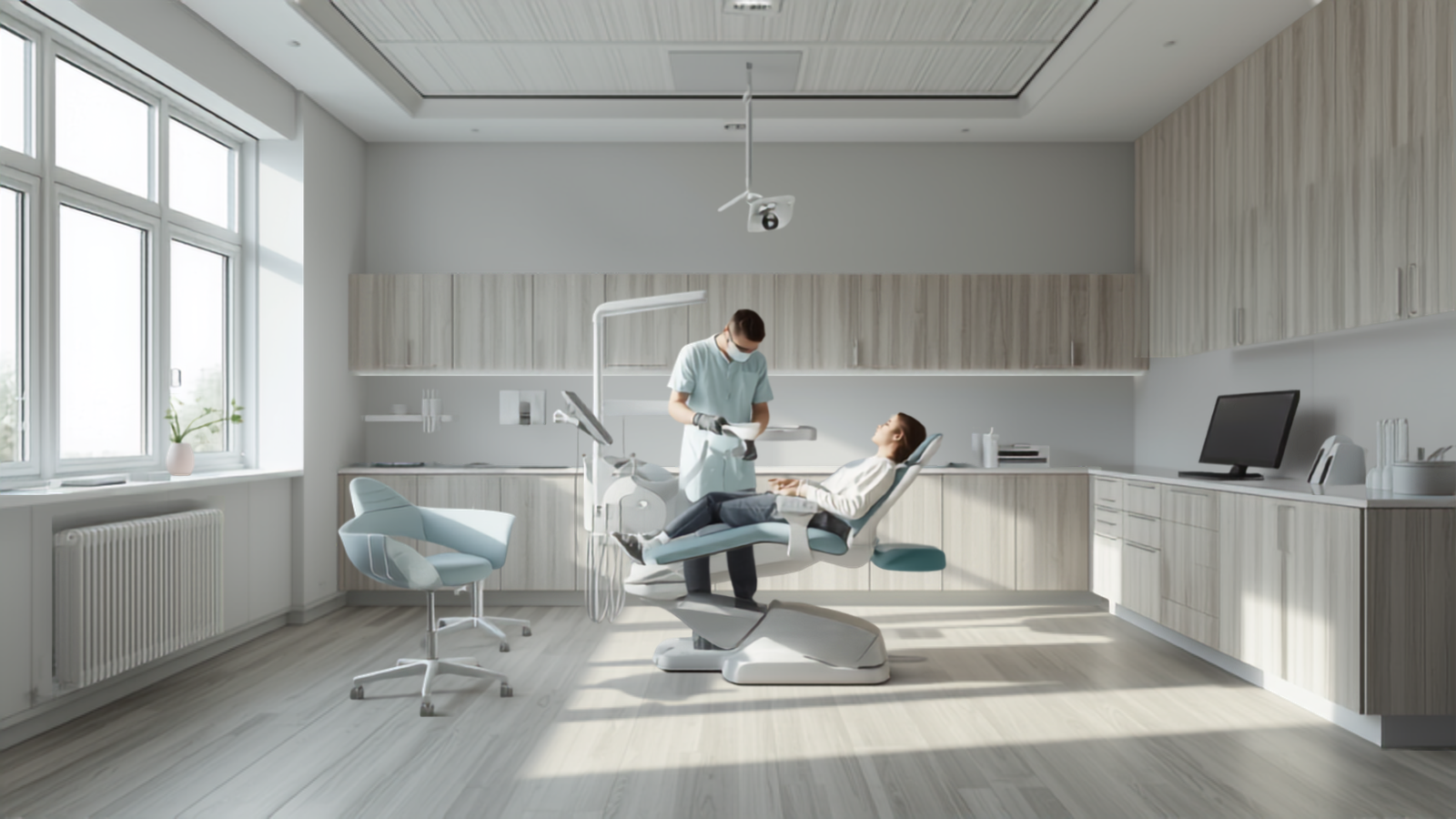
Dental Health in Transition: Why Digital Documentation is No Longer Optional
Your journal is now reporting data on its own – and soon it might be written while you still have your hands in the patient's mouth. The dental health service is in the midst of a quiet digital shift.
For a long time, dental health has been one of the most independent parts of the Norwegian healthcare system. You keep records, document findings, plan treatment – and much of that has happened within systems and routines that have been in place for many years. Now, several things are in motion simultaneously: data from the dental health service will be reported to a national registry, electronic health record systems are moving to the cloud, and artificial intelligence is beginning to make the documentation work itself easier.
For those working clinically, this doesn't primarily mean new buttons to learn. It means that what you write – and how well-structured you write it – will have significance beyond your own patient record. This post looks at what the changes actually involve for the everyday lives of dentists and dental hygienists, and why good documentation is no longer something you do «on the side,» but something that is built into the service itself.
Your journal now speaks with the rest of health-Norway
The largest and most concrete shift in 2026 is that dental care services have begun reporting data to the Municipal Patient and User Registry (KPR). From January 1, 2026, county municipal dental care services are obliged to report, and from May 15, 2026, other dental care services also joined. The reporting happens automatically from the electronic health record system, daily and change-based – meaning only new and changed information is submitted, without you having to do anything extra manually.
What is reported includes treatment types, diagnoses, and certain demographic information. The purpose is to provide a better knowledge base for management, financing, quality, and preparedness in the service – and to enable research on dental health in the same way as in the rest of the health sector. Dental health has historically been a blank spot on the national data map; it is now being filled in.
For the individual practitioner, the point is simple, but important: When your journal is the source of national statistics, the quality of what you document becomes more than an internal matter. Diagnoses that are precisely recorded, treatment that is correctly coded, and coherent notes form the basis of how dental healthcare is understood and prioritized at a system level. It is not a new requirement to write ocean – there is a good reason to write Good.
From local database to the cloud – and what it requires of you
Alongside the reporting requirements, the medical record systems themselves are changing. Tannhelse-Norge is in the process of transitioning from locally installed software to cloud-based solutions where medical records, X-rays, appointment scheduling, and patient communication are all consolidated in one place. The discussion about the future of dental record-keeping systems has been lively throughout 2025 and 2026, including in forums such as the Social Dentistry Forum.
The shift to the cloud isn't just about where data is stored. It's about information becoming more mobile and more shareable – and therefore also more vulnerable if not handled correctly. For dentists, who treat children, adults, and vulnerable groups, data privacy isn't a technical detail, but part of professional due diligence. We have previously written about why this is important. where your patient data is actually processed, and that point becomes even more important as more systems move to the cloud.
The requirement to keep records remains the same as before. Health Personnel Act mandates all those with a duty to document to keep records of each patient, and the requirements for what the record must contain apply regardless of whether the system is old or new, local or cloud-based. The digital shift does not change bet You have to document it—that changes the context and raises the bar for ensuring that the documentation is consistent across systems.
When documentation can be written while processing
This is perhaps where the greatest benefit lies for the dentist’s daily routine. Dental treatment is physical work: the hands are busy, the eyes are focused on the mouth, and notes are often written afterward—at the end of the day, from memory, when the details have begun to fade. This is a well-known source of both wasted time and inaccuracy.
Speech-to-text works in reverse. Instead of typing the note after the patient has left, you can speak your findings aloud as you work – much like many dentists already do when dictating caries findings, pocket depths, or treatment plans to their assistant. A tool like Medivox is built for this exact workflow: it captures what is actually said during the consultation and delivers a structured draft for the medical record, giving you something to build upon instead of a blank field. In Medivox, personal data is pseudonymized before the data is further processed, and all data processing occurs at Norwegian data centers.
Two things are worth emphasizing. The first is that You own the journal and make the final assessment. – the tool provides a draft, you approve and edit. The other is that a dentist does not work like a general practitioner: the terminology, templates, and workflow are different. Therefore, you build your own templates tailored to your practice, whether you run general dentistry, orthodontics, or public dental health. Good structure in the patient record – which now also means good structure towards KPR – becomes easier to maintain when the template is made for your specialty.
A field that’s taking action—not just going digital
It's easy to experience digitalization as something that happens with A dental practice from the outside: new requirements, new systems, new logins. But what is actually happening in 2026 is that dental health is moving into the same infrastructure as the rest of health Norway has been building for several years – with common registers, shareable data, and tools that simplify administration.
Dental health is not alone on this journey. The same issues regarding the burden of documentation, structure, and time spent are common to optometrists, physical therapists, and other professions that rarely top the health technology agenda. And as we have seen in The dentist's daily journal routine, it’s not the sheer volume of documentation that’s the most challenging—it’s the fact that it must be accurate, thorough, and completed while you’re giving the patient your full attention.
The good news is that the three changes are interconnected in a way that can actually make everyday life easier. Better data input into KPR requires good structure. Cloud-based systems make that structure shareable. And speech-to-text makes it easier to produce that structure without spending evenings on post-processing. The question is no longer about Dental health will be documented digitally and systematically – that's how you achieve the lowest possible time cost.
Frequently Asked Questions
What does KPR reporting mean for me as a dentist in practice?
In practice, reporting happens automatically from your patient record system – you don't submit anything yourself. However, because diagnoses and treatments are now included in a national registry, it becomes even more important that you record this precisely and in a structured manner in the patient record.
Do cloud-based medical record systems change the requirements for record-keeping?
No. The obligation to maintain records and the requirements regarding their content are set forth in the Health Personnel Act and apply regardless of the system used. The cloud changes where the data is stored and how it is shared, not what you are required to document.
Does speech-to-text work for dentists when much of the treatment is silent work?
Yes. The tool picks up what you say out loud – findings, goals, treatment plan – and structures it into a draft. Many dentists already say their findings out loud while they work, and that is precisely the workflow this is built for.
Is it safe to use an AI tool on patient data in dental care?
With Medivox, personal data is pseudonymized before the data is further processed, and all data processing takes place at Norwegian data centers. You own the record and make the final assessment before anything is stored.
Use Medivox for free – Get started completely free
Would you like to see how speech-to-text fits into a dental practice with custom templates and terminology? Contact us – then we'll show you how Medivox can be customized for your clinic.
Sources:
- Norwegian Institute of Public Health (2026) Dental Health Services (KPR TANN)
- The Directorate of Health (2026): Reporting to the Municipal Patient and User Register (KPR)
- Norwegian Directorate of Health Dental Care Services in Norway – Introduction and Summary
- Lovdata Health Personnel Act Section 39 – Duty to Keep Records


 English
  Norwegian