
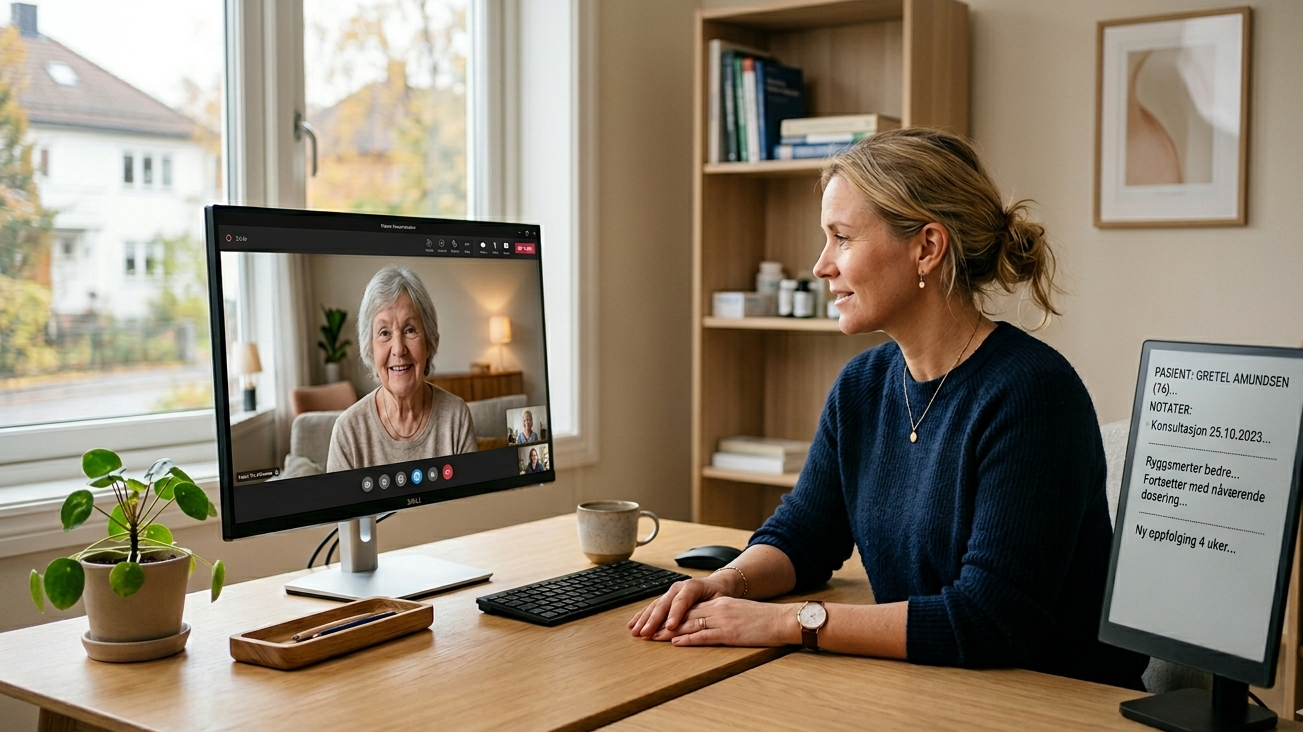
Video consultation became mandatory on April 1st – but who documents the conversation?
Starting this week, all general practitioners in Norway will offer video consultations. This is a milestone for patients. But for doctors, it means one more thing: even more to document.
Something historic happened on April 1, 2026, and it was no April Fool's joke. From that date, all general practitioners in Norway required to offer digital consultations – via video, text, and phone. In addition, everyone must offer digital appointment booking through helsenorge.no. The claim is enshrined in the new primary care physician regulations Which entered into force on January 1, 2026, with a transitional period until April for the digital requirements. From a health policy perspective, this is a clear signal: Norway is to become the world's most digitized healthcare service, and general practitioners are expected to lead the way. For patients, this is unequivocally positive. The elderly will no longer have to travel to the doctor's office for simple follow-ups. Parents with sick children can speak with the doctor without taking time off work. Patients in rural areas will have access to their general practitioner without long travel times. But for the general practitioners themselves? A very practical question then arises.
The duty of documentation also applies to video
General practitioners are not fundamentally opposed to digital consultations – quite the opposite. study from the first year of the pandemic It was found that the patient was well known to the primary care physician in approximately half of the video consultations – and for these patients, the physicians felt that video was at least as suitable as a physical consultation. Efficient, accessible, and well-suited for following up on known patients. But here is the challenge that is rarely discussed: The duty of documentation is the same regardless of the consultation method. A video consultation requires just as thorough record-keeping as an in-person meeting. And unlike a physical office, where the physician can dictate or take notes while the patient is present, many find that video consultations create a different rhythm – faster, more focused, but with fewer natural pauses for writing. The result? The medical records end up being yet another task for the evening.
The counter-voices that should also be heard
The demand has not met with only applause. The Norwegian Medical Association has been openly skeptical that video consultations be introduced as a requirement. Their argument is simple and real: A video consultation takes just as long as an in-person consultation. It does not solve the capacity problem that the general practitioner system is already struggling with – it merely shifts the time into a new channel. And the numbers give them a certain point. After a sharp increase during the pandemic, the use of video calls with general practitioners has fallen back to 1-2 per mil of consultations. At the same time, far more patients want to use video than have actually tried it. So, there's a clear gap between patient expectations and doctors' daily lives – and it's general practitioners who are caught in the middle of this gap. Then there's the documentation, again. Helfo has previously conducted checks. regarding GPs' use of e-consultation fees, and found that a significant proportion of invoices did not meet the documentation requirements. It's not about fraud – it's about precise record-keeping taking time, and time often isn't available. When documentation is insufficient, the consequence can be post-audits and demands for repayment that hit the clinic hard. The requirement for video consultation is therefore not just a technical exercise. It affects a corps of GPs already strained by time, documentation, and priorities. The most important question then becomes how to make everyday life easier – not harder.
The profit that has already been documented
For many general practitioners, the time savings from AI-supported record-keeping are significant. Instead of spending evenings finalizing notes, the journal text can be generated automatically during the consultation. This frees up time both during and after the workday – and helps ensure that documentation no longer competes with patient time. And this is not just promising technology on the drawing board. According to Norwegian Directorate of Health's healthcare personnel survey from 2025 har 61 % av fastlegene allerede tilgang til verktøy som genererer journalforslag basert på lydopptak fra konsultasjoner, og 41 % bruker slike verktøy regelmessig. Og New research shows that AI documentation saves doctors around 30 minutes per day. – an everyday difference that also reduces the risk of burnout.
Video consultation + AI documentation = the natural combination
Think of it this way: When you're already in front of a screen with good audio and a structured conversation, everything is set up for AI to help you with documentation in real-time. The video consultation actually better prerequisites for AI-supported record-keeping than a physical consultation, because the sound is clearer and the conversation is often more focused. Medivox transcribes the patient conversation and generates progress notes, letters, and referrals as you speak with the patient. Whether via video, phone, or in person. You talk to the patient – Medivox takes care of the rest. And the best part? You no longer have to choose between being present with your patient and documenting thoroughly. We've written more about The difficult choice between the patient and the keyboard – and why it shouldn't be a choice at all.
What does this mean for you as a general practitioner?
The video consultation requirement is here. It's not something you can postpone or opt out of. But how You handle the documentation, it's up to you. You can continue to write journal notes manually after each video consultation. Or you can let the conversation document itself – with a tool built for Norwegian healthcare, with pseudonymization of patient data and all data processing at Norwegian data centers. It's not about working harder in your digital everyday life. It's about working smarter – so you have time for what truly matters. Whether that's the next patient, or an early afternoon at home.
Try Medivox for free – Start your free trial
Would you like to know more about how Medivox works with video consultations? Contact us – We'd be happy to show you how.
Sources:
- Government.no (2026): You can now have video consultations with your primary care physician
- Regjeringen.no (2025): Soon, all residents can have video consultations with their general practitioner
- Lovdata (2025): Regulation on the General Practitioner Scheme in Municipalities (General Practitioner Regulation)
- The Norwegian Directorate of Health (2025): Healthcare Personnel Survey on Digitalization 2025
- Journal of the Norwegian Medical Association (2023): Effective communication in a video consultation is a double-edged sword
- Sykepleien.no (2026): You can now have video consultations with your primary care physician
- Altinget (2025): GPs must offer video consultations: – Can challenge capacity and priorities
- NRK (2025): New regulation: All general practitioners must offer digital consultations
- Helfo: Helfo has controlled general practitioners' use of fees for e-consultations
 English
  Norwegian