
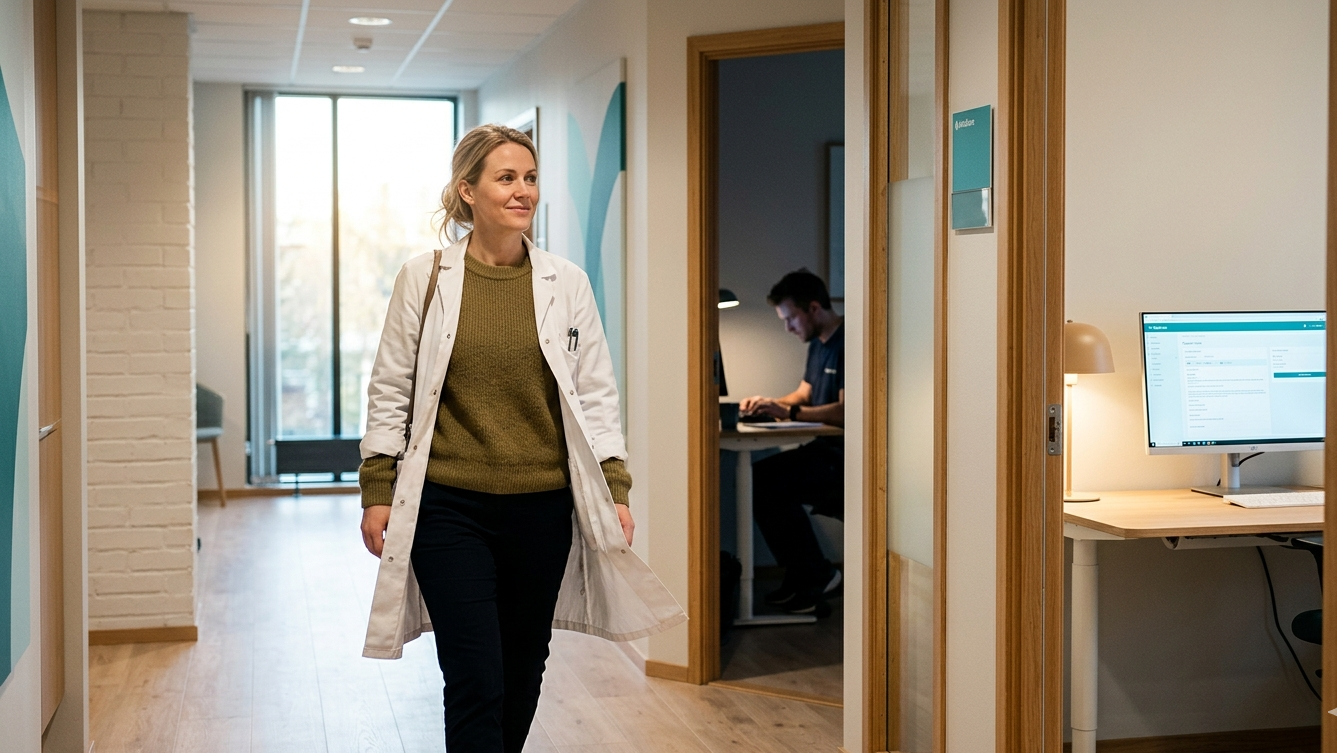
Your colleague is already dictating the medical record—here's what they've learned
A silent revolution is underway in Norwegian doctor's offices. However, it has barely reached hospitals, home care services, or psychology practices. New figures show a growing digital divide.
It's a story that tells itself in two numbers: 61 %and 4 %.
According to Norwegian Directorate of Health's healthcare personnel survey from 2025 61 percent of Norwegian general practitioners have access to tools that automatically generate journal suggestions based on audio recordings from consultations. More than four out of ten use such tools regularly.
For alt healthcare personnel gathered? Only 10 percent have access. And only 4 percent use them regularly.
This means that general practitioners are already living in a different reality than most of their colleagues in the healthcare sector. And the gap is widening.
A normal morning – two completely different realities
It's 7:45 AM at a general practitioner's office in Bergen. Dr. Pettersen starts with the first patient of the day. She speaks with the patient, asks questions, examines them. Medivox transcribes the conversation in the background. When the patient leaves, the medical record is ready for review. Dr. Pettersen spends 30 seconds verifying and approving it.
Meanwhile, at an outpatient clinic in the same city, psychologist Hansen is seeing her first client. After 45 minutes of therapy, she sits down to write her progress note. That takes 20 minutes – if she's quick. She has seven clients today. That amounts to almost two and a half hours just for documentation.
To healthcare professionals. Same city. Same day. Completely different documentation burden.
We have previously written about the documentation crisis among psychologists – that a psychologist only wrote two journal entries in 76 therapy sessions. Not because she didn't care, but because time simply didn't allow.
Why are general practitioners so far ahead?
There are several reasons why general practitioners have adopted speech-to-text technology faster than others:
The consultations are shorter and more structured. A typical GP consultation lasts 15-20 minutes, with clear questions and answers. This allows for predictable conversations that are well-suited for AI transcription.
The documentation burden is enormous. General practitioners often handle 20–30 patients daily. Without effective tools, this means hours of documentation work in the evenings. The need for relief is urgent.
Helfo checks have created awareness. We have written about What Helfo controls mean for physiotherapy practices and when documentation becomes your best defense. General practitioners have experienced that good documentation is not just a duty – it's a protection.
The technology has been available. Suppliers like Medivox have developed solutions specifically for the general practitioner's daily work, and integration with existing electronic health record systems has lowered the barrier to entry.
The big question: What about the other 90 percent?
When the Norwegian Directorate of Health The reporter at the general practitioners is going ahead., it's an acknowledgment of what's happening. But it also raises an uncomfortable question: Why doesn't the rest of the healthcare system have the same tools?
The survey shows that 46 percent of all healthcare personnel do not have access to speech-to-text tools. In the least central municipalities, the figure is even higher – 53 percent. The digital divide is thus following geography.
And it's about more than efficiency. Nurses use almost two hours daily on documentation. Physiotherapists find that The documentation requirement eats into the treatment time.. Psychologists struggle to find enough time to thoroughly document therapy sessions. For these groups, speech-to-text isn't about a cool new innovation – it's about surviving the workday.
The shortage of nurses makes this even more important.
Norway today lacks around 4,300 nurses and specialist nurses, according to the Norwegian Nurses Organisation. SSB projections suggest that we could be short 30,000 and 2040. 87 percent of the population is concerned about the shortage, according to a fresh poll.
In this reality, it's worth asking: Can we afford to have nurses spend two hours a day writing what could have been documented automatically? Sykepleien recently wroteThe problem isn't primarily a shortage of nurses – it's how we use them.
The way forward: From 61 % to all
The government's goal that Norway will become the world's most digitized healthcare service requires digital tools to reach the entire spectrum of healthcare – not just general practitioners. The Healthcare Personnel Plan 2040, which the government is to develop this year, should have this as a central point.
Medivox is already available for nurses, physical therapists, psychologists and chiropractors – with the same benefits as general practitioners already enjoy. Pseudonymization, Norwegian data centers, and real-time journal notes generated from the conversation itself.
What started as a quiet revolution among general practitioners could become a transformation for the entire healthcare system. The only question is how long the rest will have to wait.
Frequently Asked Questions
What does it mean that 61 % of general practitioners have access to speech-to-text?
According to the Norwegian Directorate of Health's 2025 healthcare personnel survey, over six out of ten general practitioners have access to tools that generate medical record suggestions from audio recordings. Over four out of ten regularly use such tools, making general practitioners the leading professional group by far.
Does speech-to-text work for people other than general practitioners?
Yes. Tools like Medivox are available for nurses, physical therapists, psychologists, chiropractors, and specialists. The technology is adapted to the specific terminology and note structure of each professional group.
Why is there such a big difference between general practitioners and the rest of the healthcare system?
General practitioners have short, structured consultations and immense documentation pressure—up to 30 patients daily. This has made the need urgent and the threshold for adopting new tools low. Other professional groups often have longer consultations and less access to technology.
Are patient data safe with AI documentation?
With Medivox, all patient data is pseudonymized before the AI processes anything. All data processing occurs in Norwegian data centers, and no data is sent out of Norway.
Use Medivox for free – Get started completely free
Do you work as a nurse, physical therapist, or psychologist and are curious about speech-to-text? Contact us – We'd be happy to show you how Medivox works for your specific professional group.
Sources:
- The Norwegian Directorate of Health (2025): Healthcare Personnel Survey – Use and Experiences with Digital Tools
- The Norwegian Directorate of Health (2025): Healthcare professionals are working in new ways, and general practitioners are leading the way.
- Norwegian Nurses Organization: Recruit, mobilize, and retain nurses
- Nursing (2026): The problem is not primarily a shortage of nurses
- Nursing (2026): New measurement on nurse shortage and salary
- Government.no (2026): Health security

 English
  Norwegian